OpenStreetMap logo OpenStreetMap

Users' Diaries

Recent diary entries

Posted by Jiri Podhorecky on 12 January 2026 in Czech (Česky). Last updated on 13 January 2026.

Děje se toho tolik, že pokud se na něco konkrétního nesoustředím, tak už to nelze zpozorovat pouhým periferním vnímáním. A abych byl alespoň trochu v širším obraze, nakonec ke zpozorování používám i dostupné technologie tak, jak se postupně rozvíjejí.

Digitální kartografie prošla zásadní proměnou a OpenStreetMap se stala pilířem globální informační infrastruktury. Od svého založení v roce 2004 se tento projekt vyvinul v unikátní kolaborativní databázi využívanou pro navigaci i krizové řízení. Současná geopolitická situace charakterizovaná napětím mezi mocnostmi klade na otevřená data nové nároky. Mapa již není pouhým zrcadlem reality, protože její role v politickém a vojenském rozhodování přímo ovlivňuje dění ve světě. V tomto kontextu bylo nezbytné zkoumat, jakým způsobem jsou data využívána v oblastech konfliktů a jak jsou chráněna před restrikcemi ze strany státních aktérů usilujících o digitální suverenitu.

Základem metodologie OpenStreetMap zůstala doktrína popisu skutečnosti na zemi. Tento přístup upřednostňoval fyzickou kontrolu nad územím před mezinárodně uznávanými hranicemi. Již v roce 2013 vydala nadace oficiální pokyny vysvětlující, že databáze není právním dokumentem a její obsah nevyjadřuje politické uznání jakéhokoli režimu. V Kašmíru hranice sledovala linii aktuální vojenské kontroly a v roce 2024 byl Krym zobrazován jako součást obou států s překrývajícími se hranicemi. Spor o jezero Gramos v roce 2025 musela vyřešit pracovní skupina pro integritu dat, aby zabránila neustálým změnám nevytyčené hranice.

See full entry

Posted by rphyrin on 12 January 2026 in English. Last updated on 14 January 2026.

This morning, when I woke up, I felt that something was different. The sky looked darker, the temperature felt colder, and the faint sound of drizzling rain outside carried a gloomy tone.

I immediately rushed to check the forum chat that morning, trying to scrape together information. What was going on out there?

07:17:55: “Heavy rain”
07:18:44: “Same here in Bogor”
07:19:39: “With a storm like this, how am I supposed to get to the office?”
07:39:11: “Anyone in North Jakarta who lives toward the east / near Bekasi. Is it storming there?”
07:40:20: “Yep. Storming. Starting to ease up a bit though.”
07:48:25: “Seems pretty widespread. Cikarang’s getting wind and rain too.”
07:50:04: “Still early morning but the rain is insanely heavy. What a Monday.”
07:55:41: “With rain this heavy, it’s best to just go back to sleep~”
08:00:26: “Heavy rainnn”
08:10:46: “The rain is so damn heavy.”
08:14:28: “Waiting for it to stop, but it’s just getting heavier.”
08:16:52: “This storm. No way I’m working. Just want to WFH.”

Heavy rain? A storm? How bad could it be? Here, the rain was only a light drizzle, but the darkness of the sky and the chill in the air felt very different. This wasn’t ordinary rain.

I kept reading the forum.

08:15:11: “Same in Central Jakarta, storm-level rain. Can’t work at all.”
08:29:58: “Force majeure, man. I ain’t leaving for work like this.”
08:37:55: “With rain this bad, offices should really normalize letting employees WFH, at least for sectors that don’t need physical presence."
08:40:00: “Stuck getting out of Tanah Abang. The rain’s way too heavy.”
08:45:47: “Early morning chaos in the airspace above CGK. Looks like no planes can land. Four domestic flights diverted to Lampung. Flight SQ950 had to do three go-arounds. This morning’s rain is insane.”

Huh?

So many planes couldn’t land at Soekarno-Hatta? How bad was the rain last night?

See full entry

Posted by tumbledust on 12 January 2026 in English.

1st January 2026

Happy New Year!

I went for a walk, today, to geo locate some benches. Given my physical challenges (not to mention my tendency to over do it all the time), benches are an absolute godsend — more often than not, a four-mile stroll feels like a ten-mile slog (and today, ironically, was no exception).

I got the job done, though, and bagged both benches at 51.4751546, -3.2752249 and 51.4742791, -3.2777702. There's a really cool MapComplete theme called Benches that I use a fair bit, so I've also got some photos ready.

I'll upload everything shortly — just as soon as my back stops hurting, my legs stop wobbling, and my ankle stops threatening an early retirement.


3rd January 2026

Locating a Quarry

I've decided to find and map the quarry in Plymouth Great Wood. According to Outdoor Cardiff's guide, it should be located somewhere around 51.483825, -3.257899.

The quarry was excavated in the late 1800s (starting around the 1860s) to provide ballast and building materials for the Great Western Railway (the main London to Swansea line).

The rock from the quarry (locally known as 'Radyr Stone') is a rare Triassic breccia that's famous for its deep red colour mixed with grey (limestone) and white (sandstone) clasts.

It was during the excavations that workers found a Bronze Age hoard in the quarry which consisted of two spearheads, five axes, and part of a sword blade.

After the woodland was gifted to the city by the Earl of Plymouth, ordinance survey maps from around the 1920s referenced the quarry as 'old' (which suggests that the site had since been decommissioned).

I'm not sure when I'll be heading out as steep muddy trails and wobbly old legs don't play nice, but I hope to at least get an eyeball of the place fairly soon.


7th January 2026

Around the Houses

See full entry

Comecei a contribuir com o OpenStreetMap movido pela curiosidade e pela vontade de ajudar. Aos poucos, percebi que mapear não era apenas desenhar ruas ou ajustar pontos no mapa: era participar de um projeto global que transforma informação em impacto real.

Nos últimos meses, tenho dedicado boa parte do meu tempo ao mapeamento do Vale do Rio Pardo, no Estado da Bahia. É uma região rica, diversa e ainda pouco representada nos mapas digitais. Cada nova via identificada, cada edificação revisada e cada detalhe adicionado ajuda a tornar o território mais visível e acessível para quem depende dessas informações.

Antes disso, concentrei meus esforços na melhoria do mapa de vários municípios do Sul e Sudoeste Baiano. Foram horas revisando imagens, corrigindo traçados, adicionando estradas rurais e atualizando áreas urbanas. Ver essas regiões ganhando mais precisão e completude no OSM é uma sensação de realização difícil de descrever.

Meu trabalho voluntário envolve revisar imagens de satélite, conferir trilhas, ruas e edificações, além de adicionar detalhes que fazem diferença no dia a dia de quem usa o mapa — desde ciclistas procurando rotas seguras até equipes de resposta a emergências que dependem de dados atualizados. Cada edição que faço carrega um pouco da minha atenção e do meu cuidado, porque sei que alguém, em algum lugar, vai se beneficiar daquela informação.

Também aprendi que mapear é um exercício de paciência e responsabilidade. Às vezes passo longos minutos analisando uma área para garantir que estou representando o mundo real com precisão. Outras vezes, descubro lugares que nunca visitei, mas que passam a fazer parte da minha rotina de voluntário.

O mais gratificante é perceber que, mesmo sem sair de casa, posso contribuir para que comunidades inteiras tenham acesso a mapas melhores. O OpenStreetMap me mostrou que colaboração aberta é poderosa: cada pessoa adiciona um pequeno pedaço, e juntos construímos algo muito maior.

See full entry

[Ex-YU] Naški

##Postavimo Banju Luku na (digitalnu) kartu – Pridružite se #FOSMBL

Da li ste se ikada zapitali kako možemo najbolje iskoristiti potencijal našeg regiona? Sve počinje sa podacima. Pod hashtagom #FOSMBL (Friends of OpenStreetMap Banja Luka) želimo da sve izmjene na OpenStreetMap-u u Banjoj Luci i okolini učinimo vidljivijim i lakšim za pronalaženje.

Zašto #FOSMBL? Korištenjem ovog hashtaga u komentarima vaših izmjena (changesets), pomažete u stvaranju lokalne zajednice. To nam omogućava da pratimo napredak i bolje se koordinišemo. Ali cilj je mnogo veći od samog mapiranja:

Turizam: Ažurne karte pomažu turistima da pronađu naše znamenitosti, ugostiteljske objekte i staze.

Ekonomija: Precizni podaci su ključni za logistiku, lokalne biznise i ekonomski razvoj.

Vizija: Vrijeme je da razmislimo o formiranju zvanične OSM grupe za Banju Luku i regiju. Zajedno možemo organizovati “mapatone” i unaprijediti kvalitet podataka na viši nivo.

Hajde da zajedno pokrenemo Banju Luku u digitalnom svijetu!


[DE] Deutsch

##Banja Luka sichtbarer machen – Ein Aufruf an alle Mapper

Hast du dich jemals gefragt, wie wir das volle Potenzial unserer Region ausschöpfen können? Alles beginnt mit Daten. Unter dem Hashtag #FOSMBL (Friends of OpenStreetMap Banja Luka) wollen wir ab sofort alle Änderungen in OpenStreetMap in und um Banja Luka bündeln.

Warum #FOSMBL? Indem wir diesen Hashtag in unseren Changeset-Kommentaren verwenden, machen wir unsere Arbeit sichtbar. Es hilft uns zu sehen, wer woran arbeitet, und Fortschritte gemeinsam zu feiern. Aber es geht um mehr als nur Linien auf einer Karte:

Tourismus: Aktuelle Karten helfen Gästen, unsere Sehenswürdigkeiten, Cafés und Wanderwege zu finden.

Wirtschaft: Eine präzise Infrastruktur ist die Basis für Logistik und lokale Unternehmen.

See full entry

Mir ist aufgefallen, daß die Überwachungskameras, die an jeder U-Bahn-Station im Raum Nürnberg-Fürth hängen, in OSM kaum verzeichnet sind. Ich habe daher angefangen, alle, die mir beim Warten auf die U-Bahn auffallen, einzuzeichnen. Dafür verwende ich Vespucci am Handy mit folgenden Tagsets:

man-made:surveillance
surveillance:public
surveillance-type:camera
surveillance-zone:public_transport_platform
camera-type:#ist entweder fixed oder dome
camera-mount:#ist entweder wall oder ceiling
camera-direction:#oft nur geschätzte Richtwerte
camera-angle:#ich versuche, mit der Android-App Clinometer möglichst akkurate Schätzwerte zum Neigungswinkel zu bekommen, funktioniert bisher erstaunlich gut
height:#nur Schätzungen
level:#selbsterklärend
operator:VAG Verkehrs-Aktiengesellschaft Nürnberg
operator-type:public
operator-wikidata:Q1557682
ref:#jede gerichtete VAG-Kamera hat an der Seite ein gelbes Schild, auf dem eine alphanumerische Referenznummer aufgedruckt ist, nach dem Schema 'VAG-NR. ###', wobei # jeweils eine Ziffer darstellt.

Die Referenznummern scheinen keinem bestimmten Schema zu folgen, jedenfalls nicht, soweit ich das nachvollziehen kann. Außerdem scheinen die dome-type Kameras kein Schild mit einer Referenznummer zu haben.

Wenn ihr Fragen oder Anregungen zu dem Thema habt, schreibt mir gerne, dann können wir ins Gespräch kommen. Fröhliches Kartographieren mittens_unofficial

Devo mappare una strada privata a uso pubblico vicino al Sentiero della Felce, sotto il Parco di Belmonte…ho visto che alcuni nodi, parti del sentiero sono stati mappati da utenti diversi, ma non questa strada carrabile.. Chiedo aiuto per indicazioni a chiunque voglia contribuire. Agosto77

Location: Trucchi, Valperga, Torino, Piemonte, 10080, Italia
Posted by JosephTJames on 11 January 2026 in English.

Quantity vs Quality Assurance

I wanted to know how well I was performing as an armchair mapper, internally I was concerned that I was creating more issues than I was helping so I learned about a website that answers the question “How did I contribute?”.

On my name I looked at the quality assurance section and the quantity of errors was too very high, almost over a 4000 issues ignored. I have attempted to improve the quality of my mapping change sets using Osmose and OSMI. OSM contributions by JosephTJames on 2025-12-30

Osmose

Initially I had 26 level 1(major) issues, 50 level 2(intermediate) issues and 800(minor). I quickly adjusted the level 1 issues and over half of my level 2 issues. I have a single level 1, 19 level 2 and over 700 level 3 issues. Systematically I hope to solve; *amenity=parking issues *building=construction issues *building overlap issues *waterway issues.

OSMI

See full entry

“I don’t know, can you?” is a joke of mediocre quality that is supposed to point out the difference between being able to do something and being allowed to do something. It is annoying to students all over because in everyday language, the word “can” gets used universally for both instances, and context clues make such comments seem pedantic. There is, however, a great place where pedantry is more than welcome: When maintaining a database, such as OpenStreetMap.

So, what’s the issue?

Access tags, including more granular specifications like motor_vehicle, bicycle or foot, specify whether someone is allowed to use a way, an amenity or whatever else. The wheelchair tag, on the other hand, specifies if it is possible to access or use the place, independent of whether it is allowed or not. Tag combinations like access=private and wheelchair=yes make perfect sense. Only a limited set of people are allowed to access a certain area, but when they are, they won’t be hindered by stairs, narrow paths or other issues that might make using a wheelchair difficult or impossible. Therefore, the only values that really make sense to use for the wheelchair tag are yes, no, limited, and designated. There are some other, user defined values that might make sense in a specific setting, but it does not make sense to apply the access tag logic to wheelchair tagging. Tag values like private, permissive and customers are an established way to convey access permission information, which is not what the wheelchair tag is.

To underline the difference between access tags and wheelchair tags, you can look at the iD editors input mask and see that they are completely different segments.

See full entry

ここでいう鉄道路線リレーションとは、route=railway(例えば、東海道本線、片町線)であり、列車の運行系統を示すroute=train(例えば、JR神戸線、湘南新宿ライン)とは違う。

修正進捗

高山本線(2026/01/06 済)

東海道本線(2026/01/10 済)

山陽本線(進行中)

東北本線

(ほか)

Location: 丸の内一丁目, 丸の内, 千代田区, 東京都, 100-0005, 日本

First and foremost, I want to express my sincere gratitude to the ESA Hub organization for selecting me for this fellowship. It was an honor to be chosen, and I am thankful for the opportunity to learn and contribute. When I began the program, I must admit I lacked confidence in the validation process. While I understood the basics of OpenStreetMap (OSM), the responsibility of critiquing and correcting other mappers’ work felt daunting. I often second-guessed my ability to distinguish between a mapping error and a local anomaly. However, looking back now, this fellowship has been a deeply enriching and practical experience that completely transformed that hesitation into technical authority.

The program didn’t just teach me how to map; it provided a robust understanding of the OSM ecosystem and the HOT Tasking Manager workflows. Through hands-on practice, I moved from simple digitization to mastering advanced tools in JOSM, including plugins, filters, search functions, and custom map paint styles.

A significant part of my growth came from the specific tips and tricks shared by my peers and mentors. I am especially grateful to Brenda, who taught me the ingenious technique of turning satellite imagery to black and white to better distinguish building outlines from the surrounding terrain. Kingsley was also instrumental, introducing us to various keyboard shortcuts that have significantly enhanced the speed and precision of my mapping and validation. Furthermore, I learned about features I didn’t even know existed, such as a ford (a shallow place in a river allowing a crossing). Learning how to identify and tag such specific infrastructure made me realize that high-quality mapping is about more than just drawing shapes; it’s about capturing the reality of the ground to aid responders.

See full entry

My experience in the 2025 Validator Fellowship for Eastern and Southern Africa began on November 3rd, 2025, and concluded on January 7th, 2026, with all sessions held remotely. The fellowship consisted of 12 countries across Eastern and Southern Africa with 42 fellows. https://www.linkedin.com/pulse/introducing-2025-esa-validator-fellowship-z0nifutm_source=share&utm_medium=member_android&utm_campaign=share_via The program kicked off with an introduction to the Java OpenStreetMap Editor (JOSM), which was followed by an in-depth examination of its advanced features. This phase was particularly enlightening, as I discovered various validation tools that could significantly enhance the validation process. Before we could dive in the fellowship one had to complete a learning lesson. https://learning.hotosm.org/course/josm-skills-series

  1. Introduction JOSM

https://docs.google.com/presentation/d/1YjRJpVQZ9BnY7xmHOswq1DDvJq5b3Id2YsEs81QWVt0/edit?usp=sharing

-JOSM training i.e mapping and validation using JOSM; task #19146, #34096

Reflecting on my earlier encounters with validation, I remember a time when my approach was rather simplistic; I would merely activate the validation tool, rectify minor errors, and quickly mark tasks as validated. My lack of confidence or hesitance to trust the accuracy of my work often deterred me from pursuing further validation, leaving me unaware of the more effective techniques that were at my disposal.

See full entry

Monatliche OSM-Kolumne, Januar 2026

OSM an der Infrastruktur-Schwelle

OpenStreetMap steht 2026 an einem Wendepunkt, der weniger dramatisch wirkt als er faktisch ist. Die Zahlen sprechen eine klare Sprache: Der Myanmar-Erdbeben-Response im März 2025 mobilisierte 3.296 Volunteer-Mapper, um 1.438.900 Gebäude und 17.603 km Straßen zu kartographieren – ein logistisches Wunder. Gleichzeitig offenbaren diese Zahlen eine unbequeme Wahrheit: OpenStreetMap ist nicht mehr ein nischenhaftes Wiki-Projekt, sondern kritische digitale Infrastruktur, die von der Bahn, DHL, Meta, Microsoft bis zum Roten Kreuz in Echtzeit genutzt wird.

Doch die Infrastruktur selbst – das Code-Gerüst, das diese Kartographie überhaupt möglich macht – zeigt Verschleißerscheinungen. Die Sovereign Tech Agency erkannte dies im Dezember 2024 und investierte 384.000 EUR über zwei Jahre, um OpenStreetMaps Kerninfrastruktur zu modernisieren. Diese Kolumne folgt den Fäden, die sich von diesem Investment bis zur State of the Map 2026 in Paris ziehen – und zeigt, warum diese Fäden in Wien beginnen, wo Fragen von Zugänglichkeit, Gerechtigkeit und Community-Partizipation nicht abstrakt sind.

Teil 1: Governance-Krise und die Resilienz-Frage

Das Defizit: Wer wartet OSMs Herz? Eine unbequeme Tatsache: OpenStreetMaps Kerninfrastruktur wird von einer Handvoll Entwickler unterhalten. Nicht Dutzend – Handvoll. Für kritische Projekte wie die Datenbank, die API und das Website-Frontend gibt es oft nur eine oder zwei Personen. Das ist nicht Schlankheit – das ist Single-Point-of-Failure-Architektur.

Die Operations Working Group (OWG) der OpenStreetMap Foundation hat zwar Oversightfunktionen, doch die Entscheidungswege sind:

See full entry

Location: KG Leopoldstadt, Leopoldstadt, Wien, 1020, Österreich

Árboles urbanos de la ciudad de Pitrufquén en OSM, 2025.

Recientemente la ciudad de Pitrufquén ubicada en la comuna homónima (Región de La Araucanía. Chile), a través de la Municipalidad solicito la elaboración de un catastro del arbolado urbano en el sector centro de la ciudad. Comprendiendo el polígono formado por las calles desde General Baquedano hasta O’higgins en sentido Este-Oeste y desde Domingo Santa María hasta Caupolicán en el sentido Norte-Sur. La superficie del polígono a mapear es de 80 hectáreas, con urgencia de ejecución de diez días entre el 19 al 29 de diciembre, antes de cierre de año. Dada las limitaciones de tiempo y presupuestarias para realizar un catastro en terreno como corresponde, se optó por la realización del levantamiento de forma virtual en la plataforma de OSM.

Se deben registrar e identificar las especies, estado sanitario, el numero de árboles al interior del polígono. Las variables que se registraron para natural=tree son:

See full entry

Location: Villa Los Jardines, Pitrufquén, Provincia de Cautín, Región de la Araucanía, Chile
Posted by CrownE8 on 8 January 2026 in English. Last updated on 11 January 2026.

Flood Risk Map of Kenya using GIS

For the doc version: Kenya Flood Risk Map

Abstract

The Republic of Kenya has recently witnessed a series of devastating hydrometeorological events, transitioning from a severe multi-year drought to catastrophic, El Niño-enhanced flooding between 2024 and 2025. These events have underscored a critical need for high-resolution spatial data to inform disaster risk reduction and humanitarian response. This research, produced as a Legacy Project for the Humanitarian OpenStreetMap Team (HOT) Community Working Group (CWG) Mentorship 2025, presents a comprehensive national-scale flood risk assessment for Kenya. The study employs a Geographic Information System (GIS) and Multi-Criteria Decision Analysis (MCDA) framework to synthesize six influential factors: rainfall intensity, elevation, slope, Land Use/Land Cover (LULC), distance to water bodies, and distance to road networks. Utilizing a weighted overlay methodology, the study reclassifies these parameters based on their hydrological and anthropogenic influence to produce a final flood risk map categorized into five classes: Very High, High, Moderate, Low, and Very Low. The analysis reveals that high-risk zones are predominantly concentrated in low-lying river basins and informal urban settlements, where high rainfall accumulation coincides with poor drainage and high exposure. The findings provide a strategic foundation for the OpenStreetMap community and disaster management agencies to prioritize anticipatory actions, refine field data collection, and enhance the resilience of vulnerable populations.

Keywords

flood, Kenya, flood risk, mapping, GIS, Multi-Criteria Decision Analysis, OpenStreetMap

Introduction

The Kenyan Paradox: Historical Context and Emerging Flood Dynamics

See full entry

It’s a pretty nice jump.

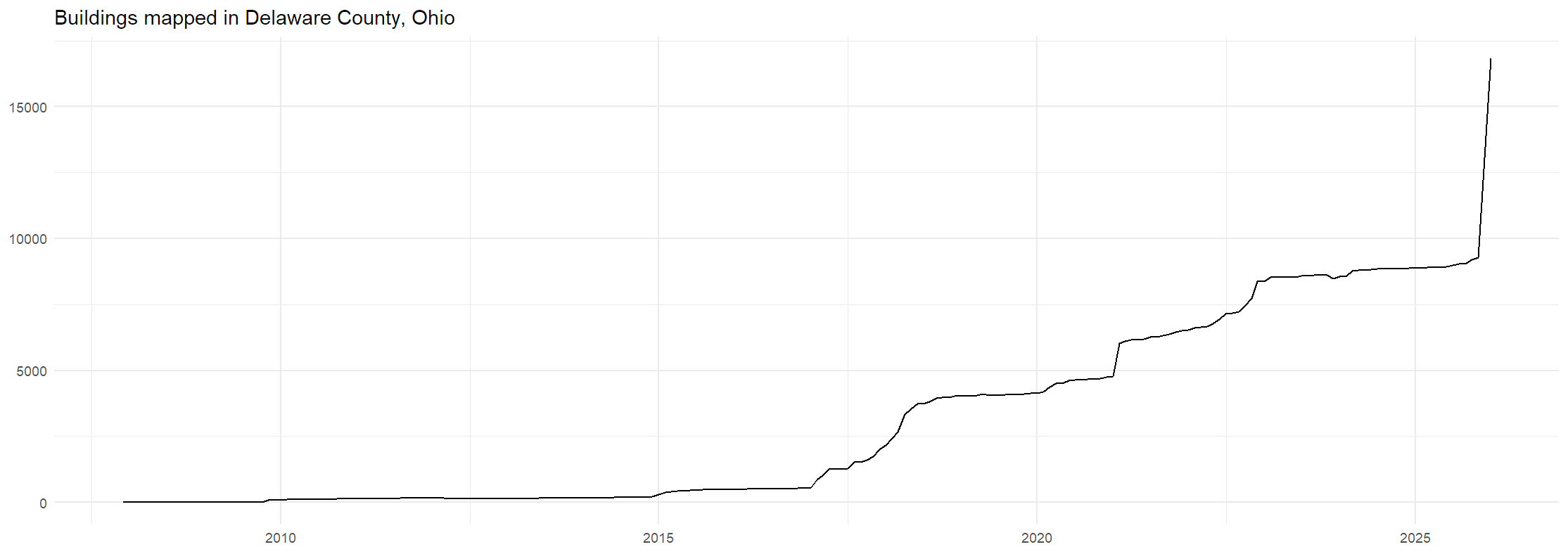
A chart of buildings mapped in Delaware County, Ohio. It spikes from around 9000 to 17000 at the end of 2025.

On November 4th, 2025, I noticed that there were 9,566 buildings mapped in Delaware County, and told a few friends that I wanted to push it up to 10,000. Since then, I’ve been mapping buildings in Delaware County daily, averaging over 100 buildings per day. Once I got it past 10,000, my next goal was to get it so that building mapping in 2025 would outpace building construction in the county. Delaware County is a rapidly growing county, so I did some napkin math and guessed that there were about 1500 buildings added to the county in the year. By the end of the year, I had easily surpassed that goal, and was now working to push back that date of keeping pace with construction further and further. You can see that in this graph:

See full entry

Location: Berlin Township, Delaware County, Ohio, United States