 OpenStreetMap

The relevance of teachers´ favorite joke for wheelchair access mapping
Posted by PizzaTreeIsland on 10 January 2026 in English.“I don’t know, can you?” is a joke of mediocre quality that is supposed to point out the difference between being able to do something and being allowed to do something. It is annoying to students all over because in everyday language, the word “can” gets used universally for both instances, and context clues make such comments seem pedantic. There is, however, a great place where pedantry is more than welcome: When maintaining a database, such as OpenStreetMap.
So, what’s the issue?
Access tags, including more granular specifications like motor_vehicle, bicycle or foot, specify whether someone is allowed to use a way, an amenity or whatever else. The wheelchair tag, on the other hand, specifies if it is possible to access or use the place, independent of whether it is allowed or not. Tag combinations like access=private and wheelchair=yes make perfect sense. Only a limited set of people are allowed to access a certain area, but when they are, they won’t be hindered by stairs, narrow paths or other issues that might make using a wheelchair difficult or impossible. Therefore, the only values that really make sense to use for the wheelchair tag are yes, no, limited, and designated. There are some other, user defined values that might make sense in a specific setting, but it does not make sense to apply the access tag logic to wheelchair tagging. Tag values like private, permissive and customers are an established way to convey access permission information, which is not what the wheelchair tag is.
To underline the difference between access tags and wheelchair tags, you can look at the iD editors input mask and see that they are completely different segments.
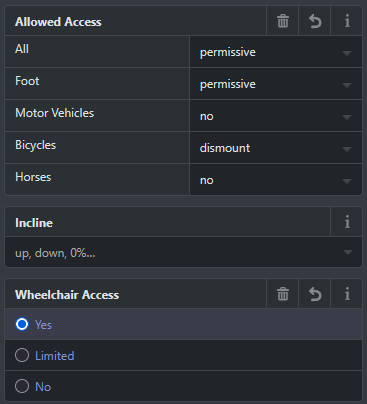
But why is this important?
Using a limited set of a few standardized tags is important for several reasons, which are especially useful in the context of wheelchair access mapping. Each of the standard values has a very specific meaning, making it possible to convey a lot of information with a single short word. Specialized apps that use the accessibility data from OpenStreetMap like wheelmap.org rely on our data being standardized and therefore machine readable. If a wheelchair tag does not fit the standard tagging scheme, it might as well not exist from the perspective of those services. That’s also why issues like typos and capitalization of tags are important because even if us humans understand what is meant by wheelchair=1yes, a non-fuzzy search will not return this place as a wheelchair accessible result. Furthermore, it is important to note that wheelchair users are people, too, and having them count as foot traffic with the same access permissions as leg users is an important mental image, not only in order to produce accurate and useful geodata, but also to view our fellow humans more generously.
Discussion