OpenStreetMap logo OpenStreetMap

Users' Diaries

Recent diary entries

OpenStreetMap steht an einem kritischen Wendepunkt. Während die globale Community die Vorbereitungen für die State of the Map Konferenz in Paris (28.–30. August 2026) vorantreibt, offenbaren sich tiefgreifende Fragen zu Governance, Datenqualität und der Frage, für wen wir eigentlich kartographieren. Diese Wochenkolumne beleuchtet aktuelle Entwicklungen, lokale Initiativen aus Wien und globale Herausforderungen, die unsere Arbeit als digitale Kartographen prägen.

Governance und Machtstrukturen im offenen Raum: Wer entscheidet, was OSM ist? Die Frage der Governance war 2025 ein Brennpunkt innerhalb der OSM-Community. Dabei geht es nicht nur um technische Entscheidungen, sondern um fundamentale Fragen: Wer bestimmt, welche Software zur Kerninfrastruktur von OpenStreetMap gehört? Wer hat Einsicht in die Entscheidungsprozesse? Und wie werden neuere Beiträger in diese Diskurse eingebunden? ​

Aktuell zeigt sich ein erhebliches Governance-Defizit. Die Kernsoftware von OpenStreetMap wird von einer kleinen Gruppe von Entwicklern gepflegt – oft nur einer oder zwei Personen pro kritischem Projekt. Das Operations Working Group (OWG) der OpenStreetMap Foundation hat zwar Oversight-Funktionen, doch sind die Entscheidungswege intransparent und häufig informell strukturiert. Dies steht im krassen Gegensatz zu anderen OSM-Institutionen wie der Licensing Working Group oder dem Tagging-Gremium, die deutlich formalisiertere Prozesse haben. ​

Die Sovereign Tech Agency hat erkannt, dass dies ein erhebliches Risiko für die Langzeitstabilität des Ökosystems darstellt. Im Dezember 2025 kündigte sie daher erhebliche Investitionen in die Modernisierung der OSM-Kerninfrastruktur an. Dies umfasst nicht nur Code-Refactoring, sondern auch Dokumentation, verbesserte Entwickler-Onboarding-Prozesse und Sukzessionspläne für langjährige Maintainer. Ziel ist es, die Entwickler-Community zu diversifizieren und damit die langfristige Resilienz des Projekts zu sichern. ​

See full entry

Location: KG Leopoldstadt, Leopoldstadt, Wien, 1020, Österreich

Árboles urbanos de la ciudad de Pitrufquén en OSM, 2025.

Recientemente la ciudad de Pitrufquén ubicada en la comuna homónima (Región de La Araucanía. Chile), a través de la Municipalidad solicito la elaboración de un catastro del arbolado urbano en el sector centro de la ciudad. Comprendiendo el polígono formado por las calles desde General Baquedano hasta O’higgins en sentido Este-Oeste y desde Domingo Santa María hasta Caupolicán en el sentido Norte-Sur. La superficie del polígono a mapear es de 80 hectáreas, con urgencia de ejecución de diez días entre el 19 al 29 de diciembre, antes de cierre de año. Dada las limitaciones de tiempo y presupuestarias para realizar un catastro en terreno como corresponde, se optó por la realización del levantamiento de forma virtual en la plataforma de OSM.

Se deben registrar e identificar las especies, estado sanitario, el numero de árboles al interior del polígono. Las variables que se registraron para natural=tree son:

See full entry

Location: Villa Los Jardines, Pitrufquén, Provincia de Cautín, Región de la Araucanía, Chile
Posted by CrownE8 on 8 January 2026 in English. Last updated on 11 January 2026.

Flood Risk Map of Kenya using GIS

For the doc version: Kenya Flood Risk Map

Abstract

The Republic of Kenya has recently witnessed a series of devastating hydrometeorological events, transitioning from a severe multi-year drought to catastrophic, El Niño-enhanced flooding between 2024 and 2025. These events have underscored a critical need for high-resolution spatial data to inform disaster risk reduction and humanitarian response. This research, produced as a Legacy Project for the Humanitarian OpenStreetMap Team (HOT) Community Working Group (CWG) Mentorship 2025, presents a comprehensive national-scale flood risk assessment for Kenya. The study employs a Geographic Information System (GIS) and Multi-Criteria Decision Analysis (MCDA) framework to synthesize six influential factors: rainfall intensity, elevation, slope, Land Use/Land Cover (LULC), distance to water bodies, and distance to road networks. Utilizing a weighted overlay methodology, the study reclassifies these parameters based on their hydrological and anthropogenic influence to produce a final flood risk map categorized into five classes: Very High, High, Moderate, Low, and Very Low. The analysis reveals that high-risk zones are predominantly concentrated in low-lying river basins and informal urban settlements, where high rainfall accumulation coincides with poor drainage and high exposure. The findings provide a strategic foundation for the OpenStreetMap community and disaster management agencies to prioritize anticipatory actions, refine field data collection, and enhance the resilience of vulnerable populations.

Keywords

flood, Kenya, flood risk, mapping, GIS, Multi-Criteria Decision Analysis, OpenStreetMap

Introduction

The Kenyan Paradox: Historical Context and Emerging Flood Dynamics

See full entry

It’s a pretty nice jump.

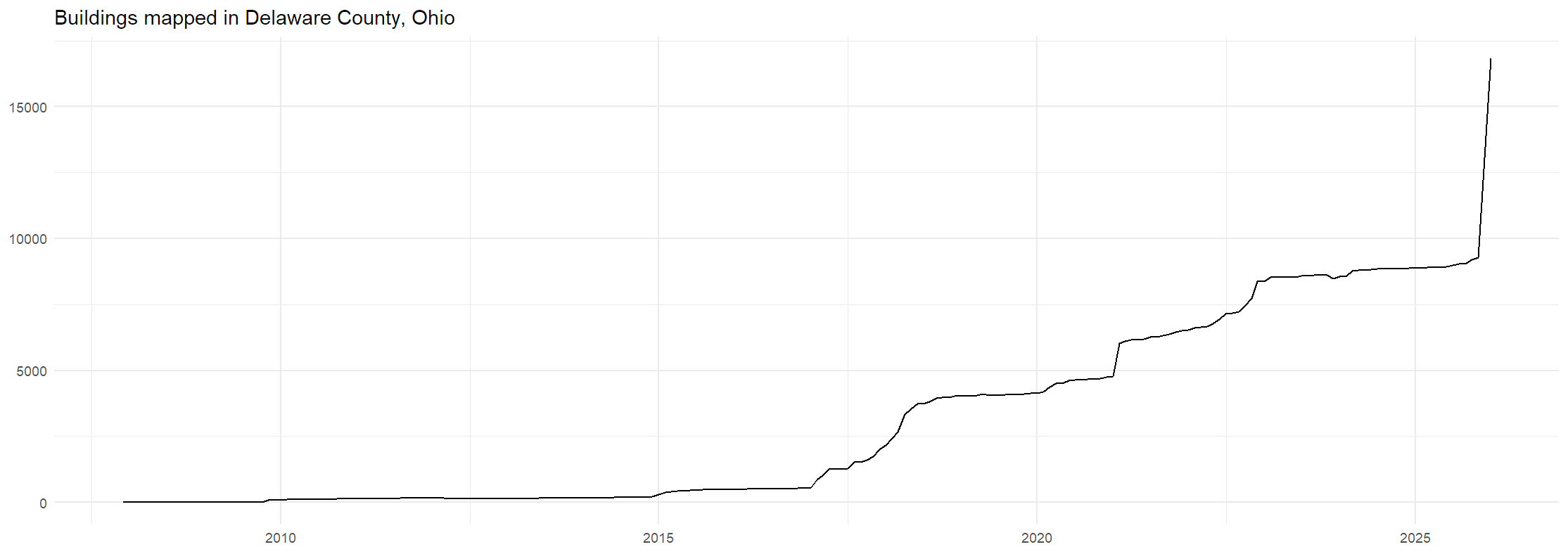
A chart of buildings mapped in Delaware County, Ohio. It spikes from around 9000 to 17000 at the end of 2025.

On November 4th, 2025, I noticed that there were 9,566 buildings mapped in Delaware County, and told a few friends that I wanted to push it up to 10,000. Since then, I’ve been mapping buildings in Delaware County daily, averaging over 100 buildings per day. Once I got it past 10,000, my next goal was to get it so that building mapping in 2025 would outpace building construction in the county. Delaware County is a rapidly growing county, so I did some napkin math and guessed that there were about 1500 buildings added to the county in the year. By the end of the year, I had easily surpassed that goal, and was now working to push back that date of keeping pace with construction further and further. You can see that in this graph:

See full entry

Location: Berlin Township, Delaware County, Ohio, United States
Posted by DiegoMGom on 8 January 2026 in English.

​I moved to Caracaraí, Roraima, for work (the banking life) in the first half of 2025. It is a quiet town.

​By the end of the year, bothered by seeing that the city’s map on OpenStreetMap consisted merely of outdated streets, the City Hall, and the hospital, I decided to join OSM on December 29th.

​It is an Amazonian town of 20,000 inhabitants. The result of this first week is over 300 changesets trying to pull the city out of the void.

​All public amenities (that I can recall), such as schools, health centers, banks, etc., are mapped. And so far, half of the city’s buildings are already drawn (long live the Building Tool plugin!).

​Honestly, I don’t know who will care about detailed mapping here in the middle of nowhere, but I wanted to do it anyway.

Location: São José Operário, Caracaraí, Região Geográfica Imediata de Caracaraí, Região Geográfica Intermediária de Rorainópolis-Caracaraí, Roraima, North Region, 69360-000, Brazil

Me mudei a trabalho (vida de bancário) para a cidade de Caracaraí, em Roraima no primeiro semestre de 2025. Cidade pacata.

Já no final do ano, incomodado em ver que mapa da cidade no OpenStreetMap se resumia a ruas desatualizadas, a prefeitura e o hospital, decidi entrar no OSM, nesse último 29 de dezembro.

​É uma cidade amazônica de 20 mil habitantes. ​O resultado dessa primeira semana são mais de 300 changesets tentando tirar a cidade do vazio.

Todos (que eu me lembre) as funções públicas como escolas, postos de saúde, bancos etc estão feitas. E até o momento metade das edificações da cidade já desenhadas (viva o plugin Building Tool).

Sinceramente, não sei a quem vai importar um mapeamento detalhado aqui no meio do nada, mas eu quis fazer assim mesmo.

Location: São José Operário, Caracaraí, Região Geográfica Imediata de Caracaraí, Região Geográfica Intermediária de Rorainópolis-Caracaraí, Roraima, Região Norte, 69360-000, Brasil
Posted by Evgeny Arbatov on 8 January 2026 in English.

I find that the width of OSM ways is a useful property for determining how good a pedestrian route is. However, it is often missing from OSM. As an experiment, I decided to use my running activities from Strava to estimate the width of a single OSM way that I use often. The specific way ID I used is in a relatively open area, meaning GNSS error is minimized. I also have collected over 100 traces of me running that single way ID over ~1.5 years. Given all this, how accurate can the estimate of the width be? I got the median width to be in the range of 11 meters. The actual width as measured with Google Maps satellite imagery is 13 meters. It’s close. I am happy with the result. I don’t have nearly as many traces for any other segment on the OSM map, so it’s a limited experiment, but the potential is promising. See the code on Github.

Location: Vinh Tuy Ward, Hà Nội, 11622, Vietnam
Posted by rphyrin on 8 January 2026 in English.

“From here, how do we get to Ragunan Zoo?”

Good question.

I paused. This wasn’t a matter of intuition; it was a routing problem.

I opened a navigation app, queried the destination, and switched the mode to public transport. The proposed solution was a multi-hop journey : take the blue commuter line to Manggarai, transfer to the red line toward Bogor, get off at Pasar Minggu, then continue with something called S15A.

S15A?

That identifier triggered a red flag. After a quick lookup, it turned out to be an angkot.

That immediately raised another question. Was there really no direct busway route to Ragunan? Not even a JakLingko alternative? Cost sensitivity was also a concern. There are plenty of public transportation modes in this city: MRT, LRT, Commuter Line, Transjakarta BRT, and Transjakarta non-BRT, but angkot and ride-hailing motorcycles are the two worst options, since they can end up being pricey due to the lack of government subsidization.

At that point, I decided to discard the initial navigation output entirely. Close the app. Start over with a more specialized tool.

I switched to the official Transjakarta application.

It refused to open and forced an update. Fine. Update first, then rerun the query.

Post-update, I defined the problem more explicitly. Assume the train leg was already completed. Starting point: Pasar Minggu Station. Destination: Ragunan. The goal was to find a replacement for the S15A angkot.

Search results came back clean. Instead of S15A, there was a JakLingko option: JAK47, Pasar Minggu–Ragunan. That was acceptable. Same endpoint, better integration.

Solution candidate number one locked in.


Then I expanded the scope. What if we removed the train entirely? What if the journey started directly from Bekasi using Transjakarta, via Vida to Cawang Sentral?

New query. New parameters. Starting point: Cawang Sentral. Destination: Ragunan.

See full entry

When I first started the ESA Validation Fellowship, I’ll admit I felt like a bit of an outsider. Even though I loved mapping, I often struggled with imposter syndrome, wondering if my skills actually measured up to the “expert” level. Looking back now, the growth I’ve experienced is incredible. I remember how intimidating JOSM used to feel with all its complex buttons and menus, but through this fellowship, it has become like a second language to me. I’ve moved past the basics and now feel completely at home using advanced tools to clean up and verify data. I learned new shortcuts and got to publicly map as others watched, proving to myself that I belong in this space.

Working alongside such talented people helped me realize that I really am an advanced mapper and a capable validator. Seeing my work hold up next to theirs finally silenced that voice in my head telling me I wasn’t good enough.

But as much as I’ve grown technically, the heart of this experience has been the people. Connecting with a global community of mappers who share the same passion for “mapping for change” has been the most rewarding part of the journey. The fellows were always helping each other out and in constant communication, a true community and something that happens only when people have common goals beyond borders. Together, we’ve been able to support humanitarian efforts and help communities become more resilient by making sure the maps they rely on are accurate and high-quality. Whether it’s a rural village or a growing city, I now understand that a precise map can be a lifeline.

This fellowship has changed how I see my work and myself. I’m walking away with new skills and if I could coin a phrase for the ESA Validation Fellowship, it would be : Certainly, what we do truly matters for the world.

Location: Kibauni ward, Mwala, Machakos County, Kenya

During the ESA HOTOSM Validation Fellowship, my journey began with the basics—learning how to install JOSM on my laptop and understanding its interface. From there, I learned how to install and use essential plugins such as the Building Tools plugin, Utils plugin, Mapathoner, and other supporting tools that greatly improved my workflow and actually made my validation easy. I also learned how to install and apply map paint styles, which helped me easily detect issues such as overlapping buildings and missing or incorrect tags, learnt how to work with different imagery such as bing, Esri and how to deal with the imagery offsets. These foundational steps laid the groundwork for my growth as a validator and deepened my understanding of data quality in OpenStreetMap. As the fellowship progressed, we moved into active validation, where I gradually became familiar with new JOSM shortcuts that made mapping and validation more efficient. Shortcuts such as B for drawing buildings, G for ungluing objects, and Ctrl + Shift + G for replacing the geometry significantly improved my speed and accuracy. As someone who had not done validation before, the daily practice sessions were extremely valuable. Validating tasks across different regions allowed me to learn by doing, and with each task, my confidence and skill level improved. This consistent hands-on practice reinforced the idea that practice truly makes perfect.

See full entry

My Growth Journey in the ESA validation Fellowship

When I was first selected for this fellowship, I felt a mix of excitement and nerves. My first major assignment was Hot Tasking Manager Project #16505, and I’ll be honest: it was a wake-up call. Initially, the tasks felt daunting. I quickly realized that while I knew how to map, I hadn’t yet mastered the advanced features required to validate data efficiently.

My workflow was slow, and I felt I was missing the technical “bridge” needed to ensure the high-quality data that a project of this scale demands. The breakthrough came through the mentorship of our facilitators. They introduced us to a suite of professional techniques and GIS tools that changed everything. Specifically, learning how to leverage advanced filters and JOSM shortcuts was a game-changer.

These weren’t just “tips” they were the keys to unlocking a much more efficient and precise validation process. By integrating these tools into my daily workflow, my technical hurdles disappeared. What once felt overwhelming now feels intuitive. This fellowship has done more than just teach me how to click buttons; it has provided me with:

  1. Technical Proficiency: A deep understanding of GIS features I previously overlooked.
  2. Confidence: The ability to validate complex data with precision.
  3. Professional Growth: A clearer perspective on the standards required in the GIS profession.

I am walking away from this experience with full confidence in my skills and a renewed passion for contributing high-quality data to the OpenStreetMap community

Posted by FRANCIS NDIRITU on 8 January 2026 in English. Last updated on 10 January 2026.

Introduction

The ESA Hub Fellowship was a deeply enriching and practical learning experience that significantly strengthened my skills in geospatial data production, validation, and humanitarian mapping. From the beginning, the fellowship introduced me to the mission of ESA Hub and the critical role that open geospatial data plays in disaster response, resilience building, and inclusive decision-making. I developed a strong understanding of the OpenStreetMap (OSM) ecosystem, humanitarian mapping principles, and the workflows of the HOT Tasking Manager, which laid a solid foundation for meaningful contributions to real-world projects.

Throughout the fellowship, I gained extensive hands-on experience in mapping and contributing to several humanitarian and disaster response projects. Using tools such as iD Editor and JOSM, I digitized key features including buildings, roads, waterways, and other critical infrastructure from high-resolution satellite imagery. I actively contributed to projects supporting humanitarian response in Sudan, Mapping for disaster resilience in Elgeyo Marakwet, and emergency response efforts for Hurricane Melissa in Jamaica, among many other projects. These contributions helped improve the availability and quality of geospatial data in under-mapped and disaster-affected regions, supporting responders and planners on the ground.

See full entry

As of December 13th, 2025, Swift and Portal interlockings have been renamed to “Old Swift” and “Old Portal”. Tracks and signals have also been renamed (2 turned into 22 and 3 turned into 33). I’ve already put in the edits.

Track diagram of Old Swift and Old Portal from NYW1-23-b

OSM: osm.org/#map=16/40.75308/-74.09527

Openrailwaymap: https://openrailwaymap.org/?style=standard&lat=40.7532&lon=-74.1037&zoom=15

NYW1-23-b: https://archive.org/details/AMTK-NEC-employee-timetable-supplemental-bulletin-20251213-NYW1-23-b

Current NEC ETT: Amtrak - Northeast Corridor Employee Timetable 2025-11-03, Special Instructions

As always, I put all bulletins and new employee timetables in this list on Archive.org

Amtrak’s FOIA office is now really fast. I can get bulletins the same day they are requested. Back in August they were much slower but now that I’m doing these every month they are on top of it.

Location: Kearny, Hudson County, New Jersey, 07032, United States

Revisei recentemente áreas da Serra fortemente afetadas pelas chuvas da enchente de 2024. Um trecho da BR-470 na região da Ponte dos Arcos sofreu múltiplos deslizamentos e, 19 meses depois, ainda opera em sistema de comboio (sentido único reversível com escolta), com longas esperas, tornando várias estradas vizinhas rotas alternativas importantes.

Ao refazer o levantamento ali, notei uma quantidade significativa de nova sinalização de advertência, principalmente para risco de desmoronamentos. Como o OsmAnd agora oferece suporte básico à etiqueta hazard, passei a mapear esses riscos quando há placas de advertência no local, pois tendem a permanecer relevantes por muito tempo.

Pensando na utilidade prática para navegação, especialmente à noite e sob chuva, decidi focar o mapeamento de hazard apenas em dois riscos: desmoronamentos ( hazard=landslide, que podem influenciar a escolha da rota quando há chuva intensa) e animais ( hazard=animal_crossing, uma fonte comum de acidentes). Outros riscos sinalizados são frequentes, redundantes ou inferíveis pela geometria da via e tendem mais a poluir avisos de navegação do que a ajudar.

Notei que a RSC-287 ainda tem 5 pequenos desvios não totalmente recuperados, quase todos mal sinalizados e com acidentes fatais recentes, mas não vi novas placas para risco de alagamento ( hazard=flooding ). Por isso, sigo usando apenas flood_prone=yes em vias com histórico recorrente de alagamento após chuva intensa, com base em notícias (infelizmente raramente precisas) e na análise de imagens históricas do Sentinel-2, adotando o critério sugerido no wiki de a via permanecer submersa por mais de 0,1% do tempo (8h por ano, ou 1 dia a cada 3 anos).

Location: Veranópolis, Região Geográfica Imediata de Bento Gonçalves, Região Geográfica Intermediária de Caxias do Sul, Rio Grande do Sul, Região Sul, Brasil

During the fellowship, I learned how to validate more effectively, especially by using filters, search functions, and setting up map paint styles. I became better at identifying issues, mapping across different countries, and validating data from other regions. This helped me understand mapping more deeply, including the different shapes of buildings across countries. I also gained a stronger grasp of quality standards and grew more comfortable using JOSM shortcuts. For example, while validating building footprints in Africa and later in Asia like Japan, North and South America, I noticed differences in building construction styles and settlement patterns. By applying filters and map paint styles, I was able to quickly identify inconsistencies such as overlapping polygons or missing tags and correct them. This experience not only improved my technical validation skills but also gave me a broader perspective on how mapping standards can be applied across diverse contexts.

During my validation mapping in Japan, I encountered a task where the same area had been mapped using two different imagery sources of Bing and Esri. This created alignment issues and inconsistencies in the data. Through the fellowship, I learned how to handle imagery offsets, switch between imagery layers and use search tools to trace a particular mapper’s edits. By applying these skills, I was able to identify the discrepancies, adjust the imagery and improve the overall quality of the map. This experience was particularly meaningful because it showed me how technical validation techniques like managing imagery sources and targeting specific edits can directly enhance data accuracy. It was a proud moment to see how my improved skills contributed to cleaner, more reliable mapping outputs.

See full entry

No dia 3 de janeiro de 2026 o grupo informal OSM Braga organizou um pequeno encontro e mapathon. Em 2024 chegámos a fazer vários encontros (físicos e online) entre maio e agosto, mas em 2025 estivemos apenas em contacto virtual através do nosso grupo no Telegram, e ao aproximar-se o final do ano, o o_andras lançou o desafio de nos voltarmos a encontrar, iniciando e coordenando a conversa que veio a resultar neste evento. Já não deu para ser em 2025, mas em contrapartida inaugurámos 2026 em grande estilo — batemos o nosso recorde de participantes, passando de 5 para 9 (poucos, mas bons! 😁)

Participantes do encontro

Além de mapeadores da cidade e arredores, juntaram-se também membros da comunidade vindos do Porto e até Lisboa (graças ao apoio da Wikimédia Portugal que se ofereceu para cobrir despesas de deslocação dos participantes). Também tivemos uma diversidade interessante de níveis de experiência, desde mapeadores experientes até curiosos que nunca tinham editado o OSM.

See full entry

Location: Braga (São Vicente), Real, Braga, Portugal

ESQUEMAS DE ETIQUETAS PARA MAPEAMENTO TEMÁTICO COM OPENSTREETMAP PUBLICADOS EM 2025


[English below]  

A empresa IVIDES DATA, associada ao Instituto Virtual para o Desenvolvimento Sustentável - IVIDES.org, publicou em 2025 quatro esquemas de etiquetas para mapeamento temático com OpenStreetMap - vilas rurais, acesso a praias, toponímia e mineração. Os documentos são resultantes de novas pesquisas conjuntas e sessões de treinamento realizados com três instituições de ensino superior brasileiras: Universidade do Vale do São Francisco - Univasf, Universidade Federal de Minas Gerais - UFMG e Universidade Federal do Rio de Janeiro - UFRJ.


Espera-se que o material gerado seja adotado em mapeamentos colaborativos que não são tão frequentes, mas que possuem importância estratégica para o Brasil e os demais países. Um dos guias está em inglês e fará parte de publicação internacional sobre acesso a praias (uma iniciativa franco-brasileira), a ser lançada ainda em 2026.


[PT] Gabarito geral para o mapeamento de vilas rurais com OpenStreetMap


[EN] Collaborative mapping of beach access with OpenStreetMap


[PT] Esquema de etiquetas no OpenStreetMap - Toponímia


[PT] Esquema de etiquetas no OpenStreetMap - Mineração


A empresa tem registro formal no Brasil (CNPJ 56.127.866/0001-12) e está aberta a novas parcerias. Contatos podem ser realizados pelo e-mail ivides [at] ivides.org.

See full entry

Posted by Sunni24 on 6 January 2026 in German (Deutsch).

Sv01_Banner

Für das Mappen komplexer räumlicher Strukturen sind 360° Street View Bilder eine großartige Unterstützung. Schnelligkeit und Vollständigkeit der Datenerfassung sind die größten Pluspunkte. Einzig die hohen Kosten waren für mich abschreckend.

Das ändert sich derzeit. Die erste und zweite Generation der Consumer 360°-Kameras kommt nun zu sehr günstigen Preisen in den Gebrauchtwarenhandel. Die Samsung Gear 360 Modell 2017 ist z.B. ab 20€ zu haben. Da musste ich zugreifen :-)

Kamerahalterung fürs Fahrrad

Ziel war, so schnell wie möglich Testfahrten machen zu können. Es kamen daher nur Komponenten in Frage, die im eigenen Lager oder beim Händler um die Ecke vorrätig waren. Das Design spielte keine Rolle, es sollte nur beim Fahren nicht stören und bei Nichtgebrauch rasch demontierbar sein.

Die Konstruktion zeigen die folgenden Bilder:

See full entry

Location: Katastralgemeinde Liebenau, Liebenau, Graz, Steiermark, 8041, Österreich

contributors

may I point you to our online mapathon tomorrow night?

Missing Maps London Online: Zoom

6th January 19:00 – 21:15 (Europe/London)

The early month meeting is focused on new mappers with breakout rooms for iD, JOSM and mappers who want to learn about validation usually with JOSM. Next one is 6 January Get your free ticket .

This Mapathon will take place online! If you wish to attend, then please get a ticket and details for joining will be shared with you.

This event is London based in name only! Since we have moved to virtual events we have been getting attendees from all over the world - we heartily welcome this!

Schedule 19:00: Introduction to Missing Maps and practical information

19:15: iD Training / JOSM Training / Validator Training

21:00: Closing discussion and potential talks

Mapy a zobrazovací nástroje

Mapovací nástroje

Mapovací zdroje a manuály

Jiné zajímavé odkazy

Location: Nižbor, okres Beroun, Středočeský kraj, Střední Čechy, 267 05, Česko