OpenStreetMap
mrpacmanmap's Comments
| Changeset | When | Comment |
|---|---|---|
| 162246700 | 8 days ago | Hi FoldForever,
I’ve now gone ahead with a + b, and have cleaned up the sidewalk/footpath that was only there to support the route. The surrounding road and path network should now be in a more locally consistent state. Thank you as well for the suggestion about handling landmarks the route passed as individual points of interest that feels like a good middle ground. I haven’t added all of them yet, but I agree that marking historically significant locations (where appropriate and verifiable) as POIs or at least under a historical:* or was:* tag is a much better fit than maintaining an inferred route. I’ll keep that in mind for future edits, and I may add some of them incrementally once I’ve verified what still exists. I massively appreciate any constructive feedback and the respectful way you’ve approached this. It’s been a really useful discussion, and I’m glad we could land on an outcome that improves the map overall. |
| 162246700 | 11 days ago | Hi FoldForever, I'm still unsure what way forward you think would be best? I'm happy to do either, but in your opinion, should I do a + b or b + c? |
| 162246700 | 13 days ago | Hi FoldForever, I completely see what you mean regarding the appearance of sidewalks stopping midway along roads, and how the mix of partially mapped sidewalks vs roads with full sidewalks can leave the area feeling inconsistent or even misleading. I agree that in isolation adding selective sidewalks for the purpose of a single route can give the impression of incomplete and messy data, especially where neighbouring roads are mapped differently. That’s a fair criticism, and I can see how this ends up being a net negative in terms of map clarity rather than an incremental improvement. Your point about routing instructions referring to “unnamed roads” is also a good point. While technically correct from a data-model perspective, I agree that from a user experience standpoint, this makes pedestrian navigation worse, not better and if improving real world usability is the goal, that’s something I agree should be avoided- it's not something I've necessarily considered before, as I've never used OSM for real world navigation personally before. On the heritage trail itself, I think you’ve reasonably summed up the broader issue. While I still feel that mapping historic or former locations can be appropriate in principle, as the route itself has been inferred rather than explicitly defined, I agree that erring on the side of caution and not keeping it as a formal route relation is probably the most sensible approach. With that in mind do you agree that the best way forward would be for me to: (a) remove the heritage trail relation itself
Thank you again for engaging so constructively; I genuinely appreciate the respectful tone and the shared focus on improving the map for the local area. If you notice anything else that looks off as I map away, please do feel free to point it out.
|
| 162246700 | 17 days ago | Hi FoldForever, please accept my apologies for the late response. I'm unable to see any notifications for your comments, so to prevent a delay like this from happening again, could you personally message me when you've responded so that I don't miss it again? I can see what you mean now about the confusing routing for the Powke Ln route. In terms of mapping the sidewalks separately, I can see both points expressed on the megathread. If you take a look at some of my recent edits, you will be able to see that I have been micromapping in a lot of detail, not too far away from the heritage walk. I have intended to eventually work my way over there once I have completed micro-mapping Oldbury. I guess I've been 'future-proofing' the area so that less work needs to be done when either I or someone else comes along in the future and maps the area in high resolution, which I can understand counteracts your all-or-nothing approach. You have an excellent point when it comes to the demolition of the municipal buildings- I was unaware of this, as it's been many years since I last passed through that, so I hadn't noticed that they were no longer there. However, I don't believe that the demolition of the buildings necessarily puts the whole trail into question due to it being a 'heritage trail'. Some trails that I have seen/mapped previously make stops at the former location of important landmarks/buildings? I guess that puts up for debate the whole intention of what a heritage trail is for? I'd like to hear your perspective on this. Sorry again for the delay in the reply, I don't feel as though you're coming across as hostile, and I hope that you don't feel like I am either, as I also want what is best for the map and the local area. |
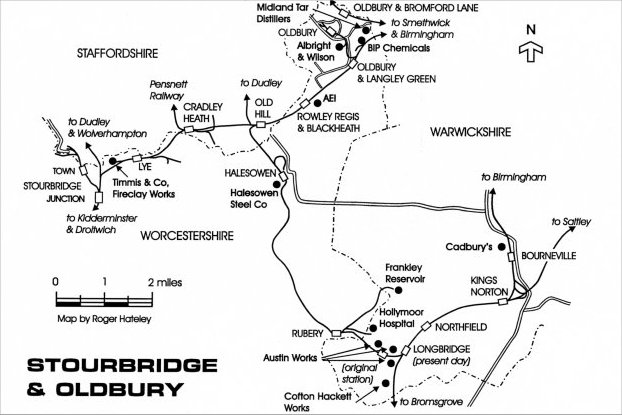
| 176364706 | 28 days ago | I believe you are mistaken, 'Oldbury and Bromford Lane' station became Sandwell & Dudley when the line was electrified, and the station was rebuilt. 'Oldbury' railway station was a different station to the south of the town centre on a spur that led from Langley Green station. Sources: https://www.blackcountryhistory.org/collections/getrecord/GB146_PHS_1246 |
| 162246700 | about 2 months ago | Hi there, I just tried to see what the issue was following your link, but the second address was invalid. Am I correct in thinking that it was from ~61 Powke Ln to ~15 Alwin Rd? If that is the case, then I can't understand what the issue is? For walking, it routes via Duke St, then down a public footpath that appears to still be open, which is the most direct route. For car navigation, it routes via the 3rd left, then 1st left, to the same destination. For Waterfall Ln Bridge, I can see that the part of the footpath I mapped is tagged as a bridge, as is standard practice for when a footpath passes over a bridge. When initially mapping the walking route, I only mapped the footpaths/sidewalks that the route would have used as it would have been too time consuming to map every sidewalk in the vicinity, I however did map a short section of footpath/sidewalk with no relation added at nodes where the path diverged to decrease the linkeness of a new mapper extending the footpath undert the relation in the wrong direction. Recently, I've been mapping sidewalks and footpaths separately to the roads they run alongside (as can be seen here: osm.org/#map=19/52.518804/-2.009531 I don't think I realised that the trail was meant to be split when I originally mapped it, as that is the case, it might be a good idea to split the route into two. I agree with your point here, though the connection does seem incorrect. Whilst the route is old, the sites along it are all still in place as far as I am aware, so someone would easily be able to still complete it, which would be a good reason to keep it? Thank you so much for getting back to me. I appreciate your response. :) |
| 162246700 | about 2 months ago | For clarification, I verified that the relation was ordered in the correct order using this tool: https://hiking.waymarkedtrails.org/#route?id=18664600&type=relation |
| 162246700 | about 2 months ago | Thank you for bringing this to my attention- I would like to get some clarification regarding your comments. I'm unsure what you mean by "the added paths conflict with existing pathways connected to the existing roads". I've taken a look at the mapped relation, and it all appears to be ordered in the correct directions. The majoroty of the route is mapped along sidewalks and footpaths that have no individual oneway=* tag; in some parts the route follows along roadways which have no oneway=* tag either; the one exception is a one way road near to Warrens Hall Riding School that flows in the opposire direction ot the trail- in this instance the member relation is reversed but this should not impact routing issues. Places where the trail crosses roads have been tagged with a marked/unmarked crossing node, as is best practice, but those individual nodes are not part of the trail relation. Where along the route are you referring to, and what impacts on routing have you experienced? In reference to the creation of "non-existent bridges", I have checked along the mapped route and can't find what you may have been referring to. Any members along the trail with the bridge tag are, in fact, bridges (such as where the trail passes over a canal). Please could you respond with some clarification as to where these bridges are? I understand your concern regarding whether or not this trail should have been mapped or not. In my opinion, as it met one of the criteria for suitability for inclusion on the map as stated on the OSM wiki ( osm.wiki/Walking_Routes#Tagging_walking_and_hiking_route_networks ) then it was correct to map it- specifically that it is "documented by an organisation [sandwell council] that is responsible for this function [encouraging and facilitating active travel to improve the health and well-being of its residents]". Although no exact trail is present on the PDF document, points have been numbered so a route was inferred by me that connected the points in a sequential order. I hope this provides some clarification regarding why the trail was mapped. |
| 163446527 | 6 months ago | Places where the roads have been mapped as split are only done so when features exist between the carriageways, such as bollards on either side of pedestrian crossing points. All of the roads in this area have correct turn restrictions for the accurate interpretation by navigational software. |
| 163340221 | 10 months ago | My apologies, this would've been done by mistake. Thank you for fixing it! :) |
| 155383595 | over 1 year ago | Hello, I believe I have corrected all of the mistakes now. Thank you for pointing it out. I've now turned on the spell checker on my browser. :) |
| 153517534 | over 1 year ago | It was assumed to be Lea Brook based on historical OS maps that show it passes here. |
| 148309473 | over 1 year ago | The bowling green pavilion is proposed/under construction as part of the BCLM's forging ahead programme. The location of the pavilion can be found here: http://planningdocuments.dudley.gov.uk/AnitePublicDocs/00491562.pdf |